Wednesday, 13 July 2016

Umkar - Living Root Bridge In The Making


The road seems to be having a hard time staving off the rapidly growing  thick vegetation straining in from both its edges. Given an ounce of earth on the tarmac they would probably spurt the next length of grass. There isn’t a soul in sight save the birds and the thickets on either sides. By now we have pretty much adjusted ourselves to sudden sighting of little streams behind dense foliage or a small waterfall gushing down the sides.  Albeit poorly. We are on our way to Siej village in Sohra to marvel at what this area is best known for.  The Living Root Bridge. And the Umkar Root bridge is one in the making ever since the original one was washed away in torrential rains.


We park the vehicle near the village school as instructed by the resort we are lodged at, and get ready to walk down a few steps to where the bridge is. A lone pineapple grows by the long steps that go up from where a matron materializes and descends to collect the fee . “ Camera? Mobile?” she asks, her lips stained with kwai. Having paid the nominal amount, we descend  the flight of steps on the other side while she goes back to wherever she came from. A teenager sits in her verandah watching us go down. Wet soggy leaves lie strewn on the wide steps and  we need to be careful lest we reach our destination in humpty dumpty style. It is the season of jackfruit ripening and as if to prove a point we come across  a few splattered on the steps. The trees are shaking off the last of the rain till the next lot pours.


The walk down to the Umkar bridge takes just a few minutes in contrast to the superstar of its ilk, the Umshiang double decker root bridge . We hear the water gushing down much before reaching the point. And there it is.  Roots twisting and turning , entwining and braiding across a stream that is jumping off the rocks. They are trained over the rocks midstream and for the rest of the way have a bamboo scaffolding to support the new roots, pushing them into the required direction.
It is an eye opener to see the roots of the Figus Elastica, a type of rubber tree, first dig deep into the ground on the bank taking shape so as to find support. The villagers  guide the secondary roots,  across and all around to lend a strong support and also to create the bridge. Bamboo poles are tied  and positioned horizontally overhead leading the tender root to the other side. The villagers of Siej aim at engineering a double decker. It would take them another two decades or so before it is fully functional.


A still photography team from Singapore is positioned on the concrete bridge running parallel to the natural one.  A root bridge ideally takes 15 to 20 years to grow and survives for many years. There is a wealth of wisdom in the Khasi forefather's  understanding the quality of the tree growing by streams helped by the heavy rainfall. It took a considerable time of their life span to see their project fructify and yet they continued to build bridges for the future generations. Bamboo or wooden bridges would rot and give away in a few years time but a living root bridge would only grow stronger and sturdier.

The first few  tentative steps on the Umkara bridge we take soon gives way to happy and delightful paces. But only till a little more than halfway. The roots are still tender and in the process of growing and reaching out to the other side helped by a bamboo frame underneath.
Buoyed by the world waking up to these bio engineering marvels, villages in Sohra are creating these bridges to cash in on its popularity. Like the one in Siej, where the aspiring double decker project is looking at more tourist inflow when it is ready. At least what they are exhibiting has not damaged nature in any way. They have only shown to the world how nature gives for generations if handled well.


On our return the girl in the verandah asks us where are we from. Her brows rise when she understands Delhi. We have a little language problem trying to share a conversation. She keeps hollering for her father and brothers, who are busy slashing the undergrowth and caring for the fruit trees on the slope beside her home. She is looking for the right words. It’s a humble home she lives in. A flight of steps leads up a high plinth and disappears into the dark doorway. There are many more bridges to be built.


This post was written for TWTFOW#5

Tuesday, 12 July 2016

Mayong And Black Magic


  "Don't look  anyone in the eye neither should you throw your gaze left or right. I for one, am not going to risk that" advised Mintu who was driving us down to Pobitora famed for dense population of the one horned rhino.
"If I am turned into a cat, I assure you, I will still find my way back home to Goalpara, even if I have to drag myself  through" he jested. Pobitora was an hour's drive from Guwahati in the Morigaon district. Mintu's concerns stemmed from the countryside we were driving through which was Mayong, the cradle of India's black magic practice.

Turning people into animals and plates stuck to their back to cure aches were a few instances of  normal occurrence of Mayong, according to the whispers. But then what else would one expect from Mayong, touted to be the capital of Black Magic of the country. I remembered little tit-bits of how people referred to Mayong in an oblique way in their conversations. That if anyone partook a bowl of tea in any household of Mayong, chances are that he would leave with the peera, a low wooden stool stuck to his rear. This was one of the most common sayings.  There was a time when it was said that every household in Mayong practiced magic and people from far and near came here to learn the art. Rumours are that it included PC Sorcar Jr. Even in the annals of history there are references to Assam as the land of sorcery and black magic. Raja Ram Singh when directed by Aurangzeb to march towards east, sought sufi saints and Guru Tegh Bahadur to accompany them as protection against sorcery. There is an interesting note of previous encounters by Shihabuddin, who chronicled Mir Jumla's march to Assam province.

"...No one who entered this country ever returned and manners of this country were never known....the people of Hindustan used to call the inhabitants of Assam sorcerers and magicians....They say that whoever enters this country is overcome by charms and never comes out of it." (A History Of Assam by Sir Edward Gait)

It is the vagaries of time then, this magical aura submerged never to rise again. Ironically the present generation, who are well in the clutches of JK Rowlings Hogwarts, Voldemort and Harry Potter, remain ignorant of a magical past of their land. Mayong remains a vague idea and not a real existence on the geographical map.

Mintu cruised ahead on the road, his aim being to reach the resort well before darkness fell. Vague stories floating down from memory coloured  the landscape we crossed. A beautiful thicket lining one side of the road had many teak trees and dense undergrowth. Rocks and boulders jutting out from within made me think of possibilities rising out of the stories. Suddenly they seemed eerie and I looked hard for any evidence of the past. The villages we crossed seemed normal with people going about their everyday chores. Nothing magical there. Quite a disappointment actually!


The resort organized a magic show that evening, probably cashing in on its lost history. Nothing extra ordinary there. I asked the staff, who were locals, about any occurrence that was out of the ordinary ambit of life. They were quick to wash off their hands.One of them smiled sheepishly, “ Frankly, our generation has not taken it up seriously. There are very few of us who would have taken the lessons of this craft. There are strict rules to be followed which becomes difficult to abide by, in the present conditions when there is a family to be fed.”

And as if to compensate for the disappointment writ large on my face he hastily adds,” I’ve heard stories from my uncle who says he has been a witness to some of them. On one occasion there was a duel between two wizards and they saw fireworks and balls of fire as they tried to counter each other’s spells and hexes. But we haven't seen magic here as far as we can remember.”

Stories again. And yet there is proof of a magical past. A museum put together by local effort displays ancient scripts bearing chants, charms and hexes. These have been collected from the homes of the people here in  order to preserve them. One suspects that people haven't really given up all that they inherited. 

Sitting there amidst the lush paddy fields, in a nicely done up resort right next to the Pobitora sanctuary, very few seemed interested in the formidable past of Mayong. It's glory and tales of enchantment eluded the present and remained amorphous in the real world.


This post was written for TWTFOW#5 


Monday, 11 July 2016

Sohra


 Sohra is a place that will play peekaboo  as you drive along the road ribboning down Shillong for almost 60 kms. The hills will ensconce you now or suddenly disappear behind a thick layered veil of clouds and tease with just a portion of the road visible ahead. But you know you are on safe grounds because the journey is through a table top and the edges are way off the road. Snaking through the  meadows in multiple shades of green, the clouds welcomed us into their folds and showered us with rains. In any case this was what I had come for, chasing the rains. 

Through the rain washed window panes, blurred landscape rushed by. I could make out a stream flowing or jumping off a rocky ledge in the meadows. A settlement passed by, people moving around unhurriedly with colourful umbrellas, an integral part of their existence. The rains had stopped as suddenly as it had begun as if to let us have a good look around. We passed  pretty Khasi homes with just one or two little windows on either side of the front door. No matter how humble the home was, there were no compromises on two aspects. Cleanliness and curtains. Every window, whether it was of a roadside kiosk, a shack, or a home had pretty curtains on their windows. And cleanliness? There was not a piece of wrapper within sight even within the compounds of their homes. Woven baskets hung from tree trunks or placed by the road was a common sight. And the roads forever had a washed look.  A string of laundry was staked up on a bamboo pole, left to dry in the breeze. Even from the distance I could make out they had been scrubbed clean. I wonder how do they dry the clothes with rain pouring in every now and then? And then I see some women attired in Jainsen  walking down to a stream with yet another pail of clothes. 

The owner of the resort we stayed in, claimed that entire Sohra once had an abundance of fruit trees and probably that's where the name came from "Soh" meaning fruits. And then came the British who couldn't quite get it right ( as is evident from the spate of renaming them throughout the country) and referred to it as Churra. The Bengali babus who assisted the British in administration further added 'punjo' to indicate a cluster. The local name Sohra changed to Cherrapunjee. The slopes of the south Khasi hills looks out at the vast watery Bangladesh. For the people of the adjoining Bangladesh plains, it made sense to   turn this side rather than trudge a long way to the nearest city. Sohra was a hub of fruits market and the local people  had trade relations with  neighbouring Bangladesh. "People here flourished then. But now they have left for distant places in search of livelihood" she claims. Tracks that connected the hills with the plains are overgrown with years of disuse. Strangely even the fruit trees started disappearing and the locals were looking at a grim future.

For all its lush greenery and rainfall, Sohra doesn't yield itself to cultivation. The traditional practice of jhum cultivation has robbed the land of its green cover. The incessant rains have added to the woes by washing away the precious top soil. A dark rocky surface juts out in many places from the greenery, lending a heightened contrast to the verdant cover. 

This region stands on a rich deposit of limestone. And soon cement factories sprung up to extract and utilize this resource. It provided respite to the locals in terms of employment and stable livelihood. Although, there are many who continue to sell off the produce from their homestead to supplement the wages earned here or at distant land. I crossed a cement factory and on the other side was a small wooden bridge that led to a row of buildings in the distance. The sky was overcast taking a respite before the next downpour. The undulating landscape was lush and fresh as only the rains can bestow. And for an instant, I wondered if the women were going to step out of their homes and wait for the men to return from the factory shift. would they hand over their earnings to the women before walking in to take a bath and sit down to a hot meal? Strangely,  Richard Llewyllen's How Green Was My Valley surfaced. But that was South Wales and the coal mines. This is Sohra and cement factory. And yet there is an echo. Probably my imagination of a Welsh countryside coincided with what stretched before me. 

Sohra continued to charm me  with it's quietude and clean air. The only sounds were that of the breeze rustling the leaves, bird songs or the rain falling in a steady pour. When the shower stopped for a while, I sat on the bamboo bench and looked out at the ridge opposite. Wisps of tinged low clouds hovered over the valley. 
"They have taken away our title" the owner of the resort had said. The ridge on the other side under the clouds was Mawsynram, wearing the crown of being the wettest place on earth. Did it make Sohra any less beautiful? Did it rob it of its quiet charm? Did it make the numerous waterfalls plunging down the cliffs any less majestic? 
I made a promise to myself, I shall return to Sohra once again and again. For that is what it does to you. Seeps into your heart with all its simplicity and stays on as a warm thought.


This post was written for TWTFOW#5


Saturday, 9 July 2016

Tin Man Of Police Bazaar Shillong


             Navigating the crowd at Police Bazaar in Shillong is  exasperating especially on a weekend. You might smirk then, what was I doing there if I found it so sapping? My answer would be, have you tried getting out of a promise made to a teenager who was tugging at your sleeve because she wanted to pick up trinkets? So I did what I do best in such situations, purse up my lips and go with the flow. Am I glad I did! For at the end of the road was a pleasant and novel surprise that had me going back to the spot.

            The surprise came much later. First there were the cries to be disentangled from, to buy the luscious plums and starfruits or carambolas, and the various assorted stuff that the hawkers were pushing. Then there were the two strap sandals in many colours bought at Rs 100 per pair. Reminded me of college days when we picked them up for Rs 20 a pair. Both sides of the street were lined with string of vendors and behind them rows and rows of shops. And between them was a flow of human beings moving both directions, some abruptly stopping and impeding the momentum. It was no different from popular market places of cities.


       We stopped at a shop displaying trinkets and realized we were in the wrong place for khasi jewellery. Someone suggested Leudah or Barabazar. But I had no patience or the inclination left to explore yet another market. And just as I  lamented about trudging our  way back all for naught, I recognized music entering my disturbed state. Long forgotten Hindi melodies blaring out of a speaker. Nothing amiss here. And then I noticed the source of it. A Tin Man!From Wizard Of Oz?


      Hanging from a string was a grinning Tin Man with plastic containers, aluminium pots and steel bowls, ladles and plates for company. Steel ladles for limbs, a grater for the torso. spoons as eyes, a bowl for a hat to cover a skull for a face, it beckoned all with it's music, apparently belted out from the torch it was thrust with to act as a mic. It was at home with all the crowd milling around while its creator dusted his wares, readying them for customers.I stood there not believing my eyes while the crowd moved on without giving it a second glance. It must have been a regular sight for them.  I was curious and watched it from every angle. "Where's the music coming from?" He pointed shyly at the taped rear of the tin man.


                                                                     Jasbir Arora

    Jasbir Arora who has been here for generations is a content man, making a comfortable sum selling his plastic, aluminium and steel utensils and containers. It was his idea to assemble his mascot out of the stuff he was selling. Sitting at home, one day he thought of creating something from the spoons and the ladles lying in his basket. One thing led to the other and soon he had a man fashioned out of the kitchen items. He then taped an 'ipod' to the back to add the music.

   " During Christmas, I make stars and Christmas trees too" he added as if embarrassed and yet happy with the attention his tin man was receiving. Now that would be an interesting assemblage of  kitchen utensils!

 During the drive back to Guwahati, it was the Tin Man that played on my mind and his creator Jasbir Arora. What ingenuous talents lie unknown in the corners of the streets!


This post was written for TWTFOW #5


Wednesday, 6 July 2016

Eid At Nazira


                                 People hugging and wishing Eid Mubarak
                                                              PC  Dreamstine

    
  It is Eid once again. And once again I'll try to recreate the pulao and the korma that Haque mami treated us to, every year during this time. But in all my  attempts, it has never arrived anywhere close to the one that stayed in my memory. When there is mindless and barbaric violence in the month of Ramzan, I fall back upon the memories of a similar time that spread warmth and brotherhood in the 'Eid mubarak' hugs. The repercussions of a political aggression to establish economic suzerainty gone horribly wrong in one part of the world has escalated and snowballed with maniacs and insane riding the tide. And yet as the holy month of fasting draws to a close, I reach out across space and time to reaffirm my faith in bonhomie that was once an integral part of the social fabric. 

My earliest memories of this day is that of standing in front of the Bajaj scooter and feeling the wind rush against my face, while my father in a skull cap rode to the Idgah outside the oil town ship of Nazira to be the first ones to wish his friends who had been fasting for the last one month. Rows and rows of men in spotless white kurta pajama offered namaaz and then turned around to hug each other. And that vision stayed as an epitome of Eid festivities. The next few days were filled with an air of excitement and anticipation of goodness just as any other festival would bring with it. My friends would be in their crisp new clothes, eyes shining and generally adding to the atmosphere of effervescence. The indulgence of ittar that was dabbed onto my inner wrist and behind the ears made me feel all too important. For perfumes were not meant for children at home. My only interest was in getting to gorge on all that mouth watering delicacies that loaded the table.  There was the aromatic pulao, the subtle melt in the mouth mutton korma, succulent chicken roast, bhuna gosht, the fish, the different types of sevaiyan, served with bamboo shoot pickle and lemon pickle to balance the rich fare.

 Outside the oil colony, Nani waited for us to have the Eid lunch together. While Moti mama got busy running to and fro the market, Nana regaled us with anecdotes of his younger days. That's how we were taught to address our parents' friends, as mamas and mamis or mahis and mohas. And that's how I guess, we became one big family. Nani with her flawless skin is long gone but  I continue to remember her as a plump cuddly warm woman always dressed in spotless white mekhela sador with one end of her sador covering her head. When we dropped in on other days, she ensured that I was treated to some freshly laid eggs from her coop in the backyard. 

Then there was Zaheer mama's home across the Dikhow river that flowed through Nazira past the homesteads on one side and the town on the other. Part of the excitement of making the trip was the boat ride and climbing up the embankment. Tucked away on the other side of the river behind a lush growth of hibiscus, henna hedges, pomegranate, bananas, plums, a rich vegetable garden that took care of the daily meals and with areca trees standing tall amidst all,that thick tropical growth, was the simple home that welcomed us with aromatic fragrance down from the river slope. 

Since there were so many it was decided to share a meal together at one place at a time. So Farahba, Fanaz, Hasan, Maina and I played outside Sabina and Samir's house while we waited for Haque mami to serve us lunch and the grown ups laughed and shared jokes inside. These were nothing more  than an extension of our evening play time together when all the children of the neighbourhood gathered to play irrespective of their age. Only, during this time there was an added air of festivity after the first air of self consciousness of the new clothes, evaporated. Soon the lingering fragrance of  ittar was rush of sweatDinner would be hosted at Farahba's house and so went on the festivities for many days till a meal at every house was ticked off. Religion was a part of the banter. "Oh! Please hide the big one! We have 'Hendoo' friends over today for a meal!", brought out guffaws and giggles.

While they  fasted, Eid was synonymous with sumptuous food as far as I was concerned. Like for every  other festival, I associated it with particular food prepared for the occasion. 

If it was Durga Puja, it had to be khichudi with begun bhaja, laabra and bilahir tok. It tasted it's best when devoured under the puja pandal along with hundreds of others. The best dahi vada was had at our neighbour, Singh uncle's house during Diwali. We never got to eat the Holi lunch, having stuffed our stomachs with the dhoklas at Patel uncle's house, the murukkus and bajjis at Rao uncle's. Even the prashad of bundiya and bhujiya during Vishwakarma puja had a taste that never felt the same anywhere else. During Bihu, our home would be flowing with guests and mother piling up the fluffy lucis and butor daail with assortment of pithas. 

Things were too good to last. A wind was blowing across Assam, gathering force and was turning into a tempest. What began as a student's movement against  apathy and gross negligence of the State towards the immigration issue, soon caught everyone and sucked them into the vortex, irrespective of religion, caste and creed. The tempest enetered Nazira and roused up the local officers of the oil company. That small motley group of local officers was broken into and transferred to different parts of the country. The festivals were never the same again. Especially not Eid.

And for days after, I badgered my mother to reproduce the fare. But it was never the same. Today I remember all of them, some have left, some have moved on and some have retired from the mayhem. And yet when Eid comes every year, a part of me looks back at the small town of Nazira and I feel grateful to have experienced and lived in what seems a mirage now. Here's to all of you who have enriched my life and to all others who can believe in what has now become a fairy tale - Eid Mubarak! And once again I shall try to recreate Haque mami's pulao and korma for my children with the hope that I can hand over a time when things were much different.


Friday, 6 May 2016

Bacchus's Other Child - Rohi


   It was Bacchus leading the way to all the hot spots of the country, where the nectar was revered and loved. A short tenure in Nasik,  the wine capital, was enough to set aside  zunka bhakar and pick up  the recipe for... not Maharashtrian delicacies but wine. Come grape season and my first lot of wine was ready to be bottled. Despite Sula vineyard ensconced not very far, homemade wine was what excitement was all about. Excitement? Well, you had to meet Coonoor's  Mr Eapen Jacob (God bless his soul) of Beulah's Farm fame, to understand the reverence with which this spirit is concocted. A winding path hugging the Nilgiri hillside, had visitors returning with Cheshire grins plastered on their faces. Reason was, of course, Mr Jacob and his famed hospitality. He reminded me of the indulgent grandma who coaxed guests to try her amla pickle, the mango pickle, the mixed vegetable pickle, the lemon pickle and all the other conceivable pickles. Mr Eapen Jacob was the gentleman with a soft smile and a sway as he stood and passionately described each of his babies. He was the perfect host who offered twenty different homemade wines for tasting, before visitors came away with those grins and armful of bottled nectar. That's what they meant to him. Nectar.


The first time the warmth of the nectar spread was in an Assamese village in Golaghat district where we were invited for a meal of the newly harvested crops ( Nowkhua). The host served a bell metal bowlful of the finest rohi, a  sweet, clear, pinkish liquid, and stepped back with eager anticipation. With every sip, the warmth spread and world became a much happier place. Sitting on the mud plastered floor on wooden peeras, with  skewered meat and fried fish fresh from the backyard pond, surrounded by golden paddy fields, life was so much simpler. That I was still in college helped in the daydreaming.


 Last year's visit to Upper Assam took us to an acquaintance's house near Silapathar. Through a neat and clean sprawling courtyard, the ripe pomelos almost touching the ground, and an array of herbs and vegetables growing in the backyard, the Mishing family greeted us like old friends. And there I met my old forgotten friend, rohi. Yes, the excitement welled up. And I acknowledged that rohi had indeed refined her presence in these parts. She was a sweeter and lighter version of the one in Golaghat. She had indeed grown elegant. For the first time I also saw where she came from.


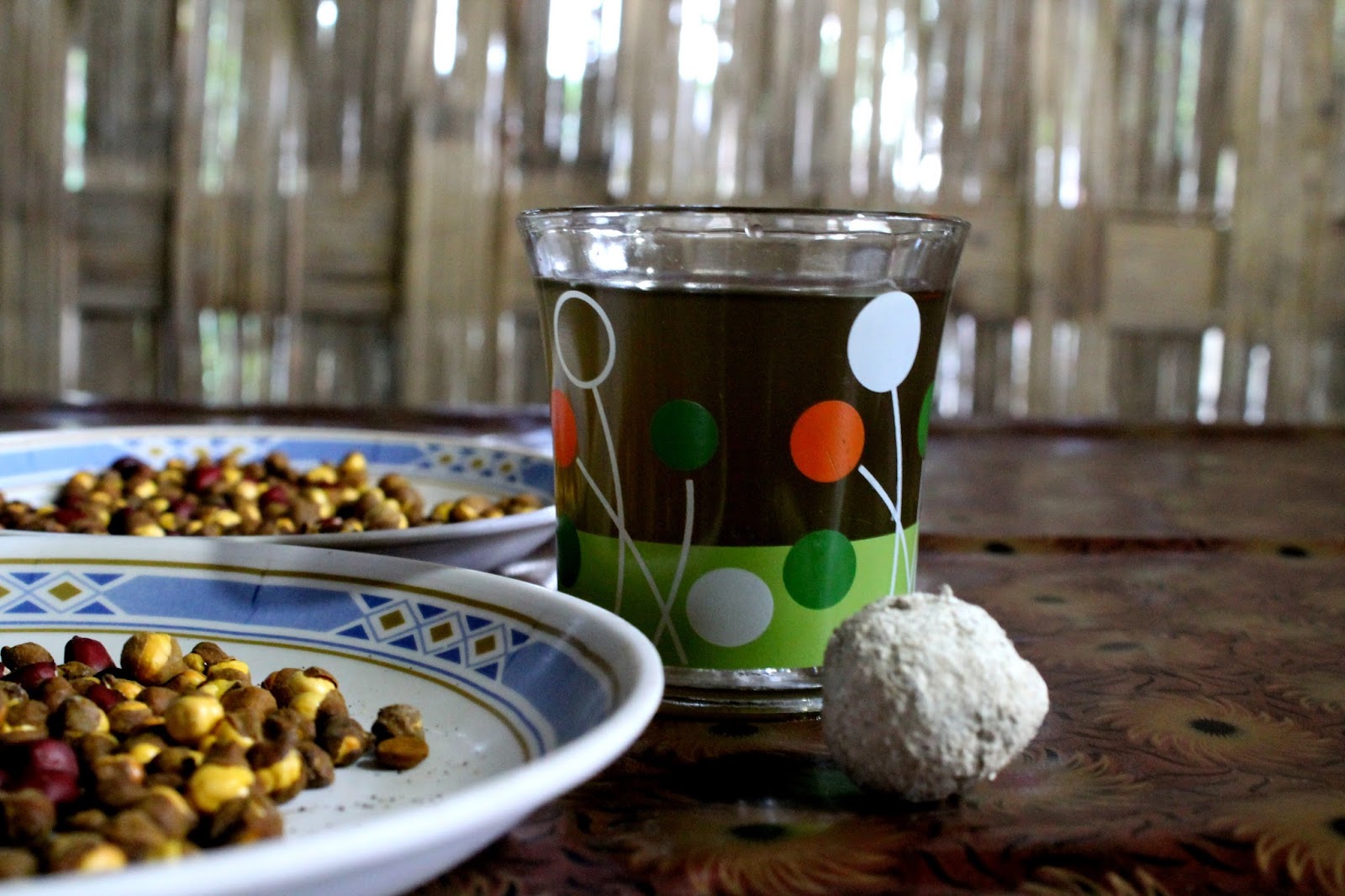
Rice is boiled and allowed to ferment for a stipulated period with 'pitha ', a rice cake with yeast and herbs. It is this 'pitha' that makes all the difference to the 'rohi'. The proportion of the ingredients is generally a trademark of every household. Although we did find these 'pithas' by the sackful in the local farmer's market, they say the ones made by the grandmas are the best. To the cauldron with the fermenting rice, some herbs are added to dissuade fungus formation in this humid tropical parts. Ash of burnt hay and straws are also mixed to this. Once it is ready for filtration, it is poured into a funnel shaped basket. The first clear liquid that seeps out from the bottom is the rohi, the finest quality of the lot. Once this is collected, more water is added  in the subsequent lot. But they do not enjoy the same finesse as the rohi.Technically speaking, it should be termed as rice beer and not wine since it is made of grain instead of grape. But the end result so belies the labels that it compels change in  positioning.


So how do I describe rohi to the uninitiated? Well you could say, champagne is the smarter sparkly exotic cousin who went to a finishing school and was exposed to a better market. Rohi, on the other hand is the elegant beauty lost in the shadows of the local ramp, waiting to step out of the wings and take center stage. And one day I hope she will get her dues. Cheers till then!


Monday, 11 April 2016

Writer's Retreat at Birdsong Cottage


They emerged from the folds and fissures, shy at first but soon  frisky, happy to have been nudged out of oblivion. Out in the open, the specks stretched in the sunshine basking in cogitation; developing into seeds for germination, pushing out the plumule to the limitless firmament; unfurling tenderly, growing extensions confidently, exploring myriad trails, filling up gaps with details, infusing life into the last tip. They clasped hands with the gossamer of bird songs and whispers of the silver oaks rife in the air. The stories soared to live lives  of  their own.

We stopped by the ledge on the narrow trail leading up the hillside, waiting for the six stories to emerge from the tapping fingers and pens. A rising melody of hope and innocence from the terraced fields below, the faraway sounds of life in a hamlet, the tweets and warbles of winged denizens, rustle of the leaves and snow peaks in the horizon played out their part in a world that was so disparate from the worlds we came from. The six of us. With tales waiting to emerge from umbra of urban life that we were gradually divesting ourselves of. While I seemed to struggle with every exercise, that pushed and pulled at every filament in the cranium, from the rest of the group tales seemed to spill and ready  like the locals who stopped and twinkled  into our cameras, challenging with their winsome smiles to capture the stories etched on their faces.

A morning session at the rhododendron forest by the hillside, bursts of scarlet on a verdant canopy, light dabbled with the contours leaving a dappled forest floor, carpeted with spent leaves, tiny elements of moss  wadding and climbing up the trunks. A breeze announced its arrival long before it caressed us and ruffled up the leaves. Stories tumbled out from behind the dark branches and took their place in the spotlight clearing,  preening, pirouetting and teasing. Its strange how tales trooped out and took form in the semi darkness of the lounge. Faint memory of conversations, an idea hanging in the morning air swooped down and wove into  narratives, criss crossing six lanes. Children in white and blue, trooped down to the nearby Anganwadi, giggling and spinning their own yarns, sweeping and cleaning before the teacher arrived, waiting for a new letter to open up their world.

  Lounging outside the Birdsong Cottage, letting our thoughts swirl around  the swallow's path, our gaze remained fixed on the serrated horizon. Bulbous shades of gray clouded over the snowy peaks of Nandadevi, Badrinath and Kedarnath. White streaks lighted up  the prologue to a spectacle, as true hosts itching to show the delightful nuances of this world to visiting seekers. Drums rolled in the ashen fluffs merging tumultuously to darken in patches. Sheets of rain tumbled down veiling the ambers, russets, the olives and the verdure in  sheer mist, thickening at times and diaphanous at others. Hail plummeted the roof and the earth, rendering all living sounds redundant. It compelled to be heard and all other words turned meaningless. We stood there watching the divine spectacle unfold in all its glory, childish joys silenced into awe. The crescendo rose with thundering claps when light fell on a patch of rooftops pushing its way through the rain, moving to a hillside making visible pearls of raindrops against the gray sky. As if on queue, the show stopper emerged and stretched across the sky in all its splendour. Each band distinct and clear and yet merged seamlessly to paint the sky with shades born of light  split through the tiny drops. Urban landscapes had only offered a part of the Whole. And here we stood gaping at the beauty of the Entire. Before our eyes the second one emerged from the corners and all that was heard were  gasps of the seekers, awestruck into wonderment.


An afternoon was spent rambling around the Guniyalakhal village, eyes feasting on the pretty slated homes cradled on the hillside, surrounded by emerald terraces and forests. Amused eyes peered out and followed the bunch of city dwellers, ever ready to soak in the sights and sounds. A few shy smiles and soon stories were swapped. They bore the common thread of yearning - for a world of aspiration reaching out from the coppiced hills and for a world lost under the herculean concrete jungle. Each side envying the goodness of the others world, brushing aside the deprivations.

Before we realized, our time was up. Three days of unbridled  exploration, teasing prompts to trickle out creativity and melting into the surroundings. We followed the river back the way we came, through its three confluences, the pristine white beaches tugging at us to stop, just one last time before the mundane swallowed us up. It cascaded and gurgled, then it changed its demeanor and saw us off at Haridwar like a composed guardian sending off her ward.


Some memories of the trip:


Verditer Flycatcher


Birdsong Cottage


Traditional  Home


Warm People


Bend On The Hillside


Snowy Peaks Enroute


Wild Daisies


Rhododendron Forest
Rudraprayag